
By Sanjay Raman Sinha
A casual observation by Chief Justice of India (CJI) BR Gavai during a hearing on the Javari Temple idol reinstallation case at Khajuraho sparked an unexpected uproar. When the petitioners pressed their plea, the CJI reportedly said: “Ask the deity to do something.” The remark, intended in jest, triggered outrage—culminating in an advocate attempting to hurl a shoe at the chief justice.
Gracefully, Justice Gavai urged authorities to “forgive and ignore” the incident. Yet, the episode rekindled a long-simmering debate on judicial restraint and the ripple effects of off-hand courtroom comments.
ECHOES OF EARLIER STORMS
It wasn’t the first time Justice Gavai found himself in turbulent waters. In February this year, while hearing a matter on night shelters for the homeless, he referred to agricultural labourers being turned into “a class of parasites” nurtured by freebies—a phrase that sparked sharp criticism.
Judges often use conversational remarks to probe arguments or test logic. However, in the age of 24×7 reporting and live streaming, such remarks escape the courtroom’s context and circulate widely. A sitting Supreme Court judge confided, off the record, that this constant scrutiny has made many judges “guarded and reticent” in their oral interjections.
WHEN SPEECH BECOMES PRECEDENT
Though oral observations carry no legal weight, they serve two crucial purposes:
1. They engage counsel, sharpen arguments, and reveal judicial reasoning.
2. They offer informal guidance to lower courts, shaping how the law is interpreted.
But the risk of misinterpretation looms large. In the landmark Mohinder Singh Gill vs Chief Election Commissioner (1978) case, the Supreme Court had already cautioned judges against spontaneous remarks that could be misconstrued or undermine judicial propriety.
MEDIA, MISINTERPRETATION, AND THE MIRROR OF PUBLIC OPINION
The balance between free reporting and judicial restraint remains delicate. The Supreme Court, in a ruling following the Madras High Court’s Covid-era criticism of the Election Commission, upheld the media’s right to report oral remarks—but simultaneously urged judges to avoid “indiscriminate statements”. Justice DY Chandrachud famously noted in the order: “A formal opinion of a judicial institution is reflected through its judgments and orders, not its oral observations during hearing.”
FLASHPOINTS THAT STIRRED CONTROVERSY
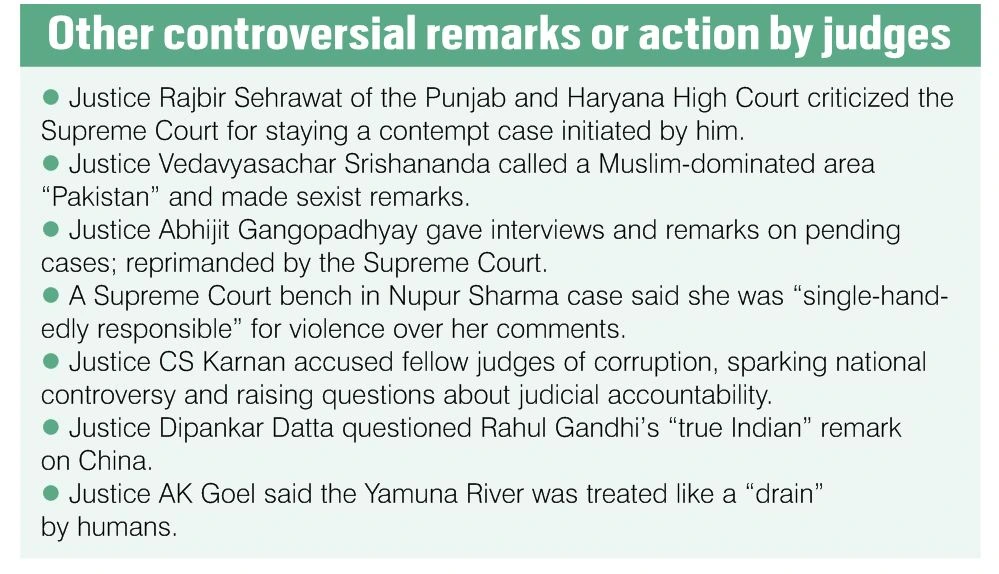
Few incidents illustrate this volatility better than the case involving Nupur Sharma, when a two-judge bench remarked that she was “single-handedly responsible” for nationwide unrest—setting off a fierce backlash.
Ironically, while the Supreme Court often reprimands lower courts for “unrestrained” commentary, its own judges have sometimes courted similar criticism. Justice Dipankar Datta, for instance, raised eyebrows by asking Rahul Gandhi’s counsel how a “true Indian” could make unsubstantiated claims about Chinese incursions.
THE AGE OF LIVE-STREAMED JUSTICE
With courtrooms now open to the world, every utterance is instantly amplified. Judges are reminded to be conscious of their own predispositions. A 2024 bench led by CJI Chandrachud observed: “As judges, we are conscious of our accumulated predispositions. Every judge must be aware of his own bias.”
Courtroom dialogue remains vital to the pursuit of justice. Yet, as words echo far beyond the bench, the need for measured speech has never been greater. The true test of judicial intent, as many argue, lies not in passing comments—but in the written order that endures.
The post When Words Weigh Heavy: The Perils Of Off-the-Cuff Courtroom Remarks appeared first on India Legal.