
By Dilip Bobb
The former chief justice, as one of his last acts in office before retiring on November 23, forwarded a report to all the High Courts. It was a request to do with updating the judiciary’s administrative nomenclature. He termed it a small, but significant step towards affirming the worth of every individual working within the country’s administrative structure. Basically, as he said, the idea is to replace outdated job titles with respectful terms to combat inequality and uphold dignity.
Some of these titles include “Cycle Sawar”, “Coolie”, “Scavenger”, “Masalchi”, “Chowkidar” and the colonial era’s most enduring and intriguing title, “Bundle Lifter”. A report from the Supreme Court’s Centre for Research and Planning had said these and several other terms used in the administrative language of the courts perpetuate a “grammar of inequality”.
The report, titled, “Reforming Administrative Nomenclature in the Indian Judiciary Embedding Dignity and Equity in Service Rules”, explained that the “grammar of inequality” referred to “the set of unwritten, hierarchical rules inherited from feudal, colonial, and caste-based systems that structure the judiciary’s administrative nomenclature”. It urges administrators to “align the language of the administration with the language of the Constitution. Close the gap between what the judiciary pronounces and what it practices. Reaffirm that language itself is the judiciary’s first act of justice—an act of recognition, pedagogy, and symbolic justice,” the Supreme Court’s Centre for Research and Planning recommended.
Justice Gavai, in his foreword to the report, said the continued use of this outdated terminology had the “unintended effect of normalising outdated hierarchies and undermining the respectful work culture that the judiciary must uphold”.
As one of his final urgings before handing over the judicial baton to Justice Surya Kant—as chief justice—he wrote that updating the judiciary’s administrative nomenclature would be a small, but significant step towards affirming the worth of every individual working within the judicial system, regardless of rank or role.
The Supreme Court’s Centre for Research and Planning had said that the archaic terminology was once used as “powerful tool of dominance that causes “thingification” of the individual. Terms such as “halalkhor”and “scavenger” violate the prohibitions of caste-based discrimination under the Constitution, the report said. “Reaffirm that language itself is the judiciary’s first act of justice—an act of recognition, pedagogy, and symbolic justice,” the Supreme Court’s Centre for Research and Planning recommended.
As a start, the report said, courts must abandon “halalkhor” for sanitation assistant, “dhobi” for laundry operator, “coolie” for freight assistant, “cycle sawar” for logistics assistant, “basta bardar” for document handler, “bundle lifter” for material coordinator, “masalchi” for kitchen assistant, “malan” for horticulture attendant and “scavenger” for sanitation assistant. In July 2025, the Supreme Court had notified a change in the nomenclature of certain administrative posts within its own registry, such as “Jamadar (Farash)” and “Jamadar (Safaiwala)”, to more modern and appropriate titles.
The report recommended replacing the following outdated job titles:
Outdated: Halalkhor, Scavenger
Suggested: Sanitation Assistant
Outdated: Dhobi
Suggested: Laundry Operator
Outdated: Coolie
Suggested: Freight Assistant
Outdated: Cycle Sawar
Suggested: Logistics Assistant
Outdated: Basta Bardhar, Bundle lifter
Suggested: Document Handler, Material Coordinator
Outdated: Masalchi
Suggested: Kitchen assistant
Outdated: Malan
Suggested: Horticulture Attendant
Outdated: Chowkidar
Suggested: Security Assistant (or similar professional title)
Under earlier chief justices, the top court also addressed the role of long-standing customs and traditions in several cases, particularly regarding religious practices and personal laws, balancing historical practices with fundamental rights and constitutional principles. In the landmark Sabarimala verdict in 2018, a 4-1 majority highlighted the principle that customs must not override constitutional guarantees of equality and non-discrimination.
However, the Supreme Court has generally avoided interfering with day-to-day rituals and sevas of a temple, considering religious scholars and priests best equipped to determine what is in accordance with customs and traditions, as it ruled in the Tirumala Tirupati Temple case. It has also stated that long-standing rituals should not be altered merely for administrative convenience. That followed what the Supreme Court laid down in the “Doctrine of Essentiality”. This doctrine allows the Court to determine which rituals and practices are “integral” to a religion and thus protected by constitutional provisions.
However, the apex court has also addressed issue of gender justice in the context of personal law customs, such as a Parsi woman marrying a Hindu being denied entry to the Tower of Silence, observing that “DNA does not evaporate” after marrying outside one’s religion.
In essence, the Supreme Court examines “outdated customs” through the lens of the Constitution, ensuring that while tradition is respected, it does not infringe upon the fundamental rights and modern legal framework of the country.
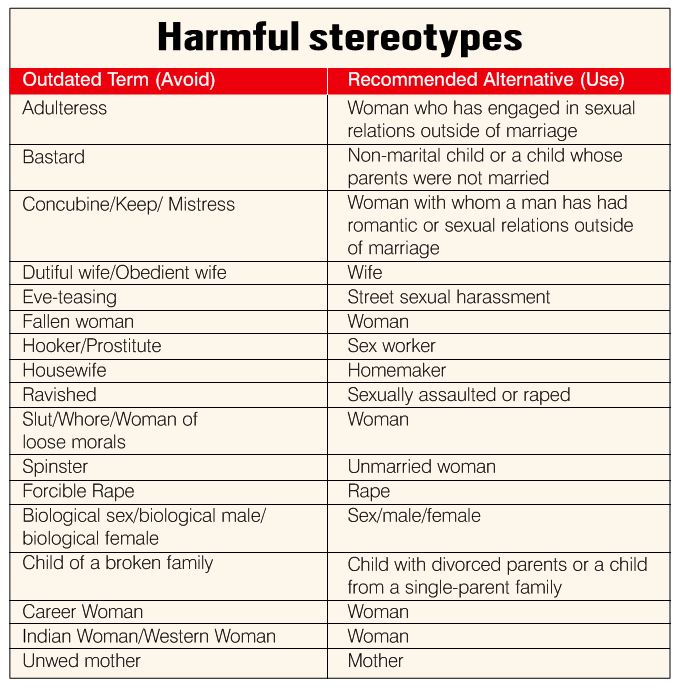
In that context, it has actively sought to remove outdated and stereotypical legal terms as laid down in the Handbook on Combating Gender Stereotypes and a separate Handbook on Disability. These handbooks identify harmful language and provide alternative, gender-neutral, and sensitive terminology for use in judicial discourse and legal documentation.
Launched by Chief Justice of India DY Chandrachud in August 2023, they aim to prevent judges and lawyers from using language that perpetuates harmful stereotypes about women. They include instructions (see box below: Harmful stereotypes).
The Handbook on Combating Gender Stereotypes makes the salient point that stereotypical language used by judges will only reinforce archaic nomenclature, undermining the individuality and dignity of a person before the Court. One example of this was the word “pauper” used in the Code of Civil Procedure, meant to refer to people with poor financial means that was later replaced by the word “indigent”.
Similarly, there is a handbook on Persons with Disabilities released in 2024 which dealt with how they should be addressed in a court of law or any legal proceedings, basically by using terms that were less derogatory and condescending.
The fact that then chief justice DY Chandrachud had two adopted daughters with physical disabilities may have played a role in that decision, but it was also long overdue, as was Justice Gavai’s parting gift which suggests that even in today’s day and age, language and usage of terms that discriminate and are stereotypical still exist and are actually quite commonplace and acceptable by the public at large.
There are many of us who still use “chowkidar” instead of security guard, and no one would think of using “freight assistant” instead of “coolie”, but the Supreme Court has reminded us about dignity of profession, regardless of how lowly it may be. It has, at the same time, reminded us that justice often happens at the intersection of law and language.
—The writer is former Senior Managing Editor, India Legal magazine
The post The Grammar of Equality: How the Supreme Court Is Rewriting Dignity Into Daily Justice appeared first on India Legal.