
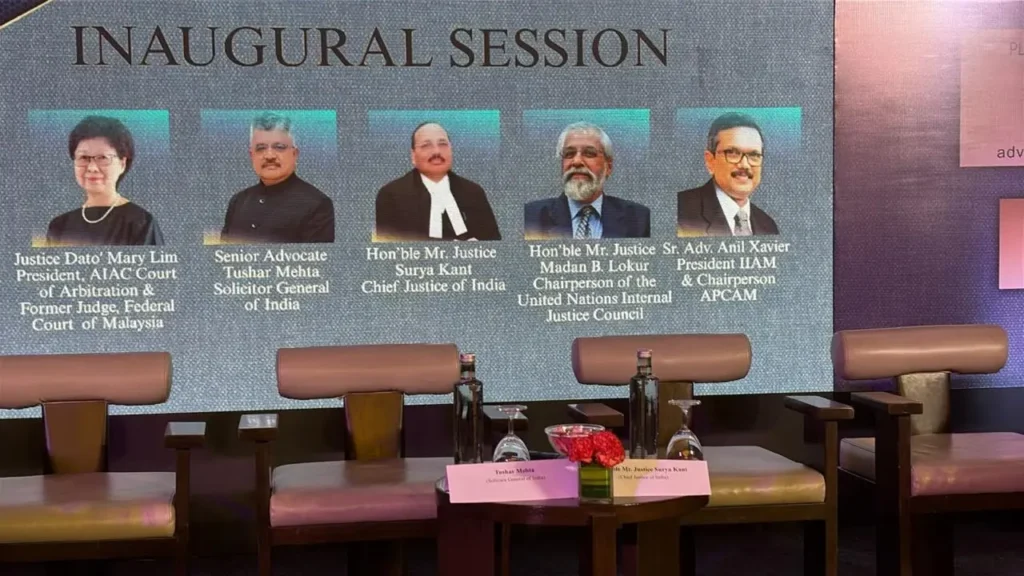
Chief Justice of India (CJI) Surya Kant has called for a comprehensive overhaul of India’s alternative dispute resolution (ADR) framework, stressing that the country must build an architecture of trust that inspires confidence beyond conventional courtrooms.
Delivering the inaugural address at the ADR Summit 2026 organised to mark the Silver Jubilee celebrations of the Indian Institute of Arbitration & Mediation (IIAM) in New Delhi on Friday, the CJI said the milestone should serve not only as a celebration of the institution’s 25-year journey but also as an opportunity to critically assess the progress made in dispute resolution mechanisms over the past two and a half decades.
The two-day summit, themed “Reimagining ADR: Innovation, Technology & the Future of Justice,” brought together judges, arbitrators, mediators, legal practitioners, corporate leaders and other stakeholders to deliberate on the future of arbitration, mediation and digital dispute resolution in India.
Congratulating IIAM on completing 25 years, the CJI said the ADR ecosystem had undergone significant legislative and judicial transformation. He noted that arbitration had evolved from functioning largely outside institutional structures to being supported by Constitution Bench judgments of the Supreme Court, successive amendments to the Arbitration and Conciliation Act and the enactment of the Mediation Act, 2023.
He added that online dispute resolution platforms had also emerged, enabling disputes to be resolved without physical court proceedings. However, the CJI said the real test was whether litigants and commercial entities genuinely trusted these institutions and mechanisms, observing that the legal architecture would remain ineffective unless people had confidence in it.
Referring to the mounting judicial backlog, CJI Kant said Indian courts were presently burdened with more than five crore pending cases, with nearly half of them pending before district and trial courts. He observed that government departments were parties in nearly half of all pending litigation, while approximately one-fifth of the cases involved land disputes that often continued for years and sometimes outlived the original litigants.
He emphasised that no adjudicatory system, regardless of the resources invested in it, could independently eliminate such an enormous backlog. According to him, a substantial portion of disputes would necessarily have to be resolved outside traditional court processes through effective ADR mechanisms.
On arbitration reforms, the CJI referred to recent landmark Supreme Court decisions, including Cox and Kings Ltd. v. SAP India Pvt. Ltd., as well as rulings concerning the stamping of arbitration agreements, stating that these judgments had corrected important aspects of arbitration jurisprudence.
At the same time, he highlighted institutional deficiencies, noting that although the Arbitration Council of India was created through the Arbitration and Conciliation (Amendment) Act, 2019, to grade arbitral institutions and accredit arbitrators, it had still not been constituted even after six years.
He also pointed out that the draft Arbitration and Conciliation (Amendment) Bill, prepared on the basis of the recommendations of the Expert Committee headed by former Law Secretary T.K. Viswanathan and circulated in October 2024, was yet to be introduced in Parliament.
Expressing concern over India’s dependence on foreign arbitral institutions, the CJI observed that Indian parties were the third-largest foreign users of the Singapore International Arbitration Centre (SIAC) in both 2024 and 2025. He said India continued to export a significant number of its commercial disputes to foreign arbitration seats and stressed the need to create sufficient confidence in domestic arbitration centres such as Mumbai and Delhi so that Indian businesses would increasingly choose them over overseas venues.
Speaking on mediation, the CJI said the Mediation Act, 2023 had provided India with its first comprehensive statutory framework governing mediation and had encouraged pre-litigation mediation to gradually emerge as the preferred first step in dispute resolution. Drawing from judicial experience in family business disputes, he observed that mediation often succeeded in preserving both commercial enterprises and personal relationships.
To strengthen mediation in the country, the CJI underlined the need for professional training and accreditation of mediators, wider incorporation of mediation clauses in commercial contracts by corporate entities, and India’s ratification of the Singapore Convention on Mediation to facilitate cross-border enforcement of mediated settlement agreements.
Addressing the growing role of technology in dispute resolution, the CJI said digital dispute resolution platforms and artificial intelligence had the potential to improve efficiency, provided they remained assistive rather than adjudicatory. Referring to the Supreme Court’s AI initiatives, including SUPACE and SUVAS, he said these technologies demonstrated the appropriate model for responsible use of artificial intelligence in the justice delivery system.
He cautioned that while artificial intelligence could assist by organising evidence, classifying disputes, managing data and preparing preliminary translations, decisions involving evaluation of competing rights and equities must continue to remain within the exclusive domain of human adjudicators. He stressed the need for an appropriate legislative framework and effective human oversight to govern the deployment of AI in dispute resolution.
Concluding his address, the CJI said arbitration, mediation and digital dispute resolution shared a common objective of ensuring that parties had access to fair, timely and enforceable mechanisms for resolving disputes outside conventional litigation. He added that building such trust required sustained efforts beginning in law schools and extending to businesses, government departments, judges, arbitrators and mediators, all of whom must earn public confidence through competence, integrity and professionalism.
The CJI also congratulated IIAM on completing 25 years of service in promoting arbitration and mediation, observing that the institution had played a significant role in safeguarding commercial interests, preserving relationships and advancing justice beyond the adversarial court system.
The post CJI Surya Kant calls for complete overhaul of alternative dispute resolution framework in India appeared first on India Legal.