
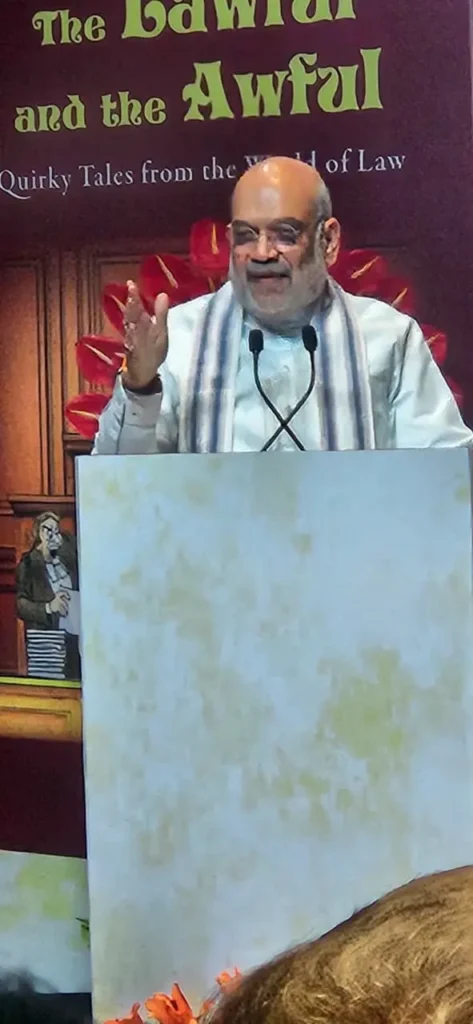
Union Home Minister Amit Shah has emphasised maintaining harmony between the judiciary and the executive, observing that the Indian constitutional framework was designed to preserve institutional balance rather than confrontation between organs of the State.
Speaking during the launch of two books authored by Solicitor General Tushar Mehta – ‘The Bench, the Bar and the Bizarre’ and ‘The Lawful and the Awful’ – at Bharat Mandapam on Sunday, Shah said that executive decisions remain subject to constitutional scrutiny by the judiciary and that constitutional conventions developed over the decades had strengthened democratic governance, institutional dignity and the doctrine of separation of powers.
According to the Home Minister, the strength of democracy lies in dialogue, institutional balance and mutual respect between constitutional authorities. He indicated that the constitutional practices and institutional equilibrium evolved between the executive and the judiciary over the years should continue to be strengthened in order to preserve public confidence in constitutional institutions.
Speaking about emerging technologies, he said artificial intelligence (AI) and emerging digital technologies could pose new legal and institutional challenges for the judiciary in the coming years, while emphasising that technological advancement and the administration of justice must function within the constitutional framework. The integration of technology into judicial processes must take place while preserving constitutional safeguards, procedural fairness and institutional accountability, he added.
Referring to the book examining the intersection of law and technology, the Home Minister observed that the publication analysed the potential impact of artificial intelligence, digital systems and emerging technologies on courts and the justice delivery mechanism. He noted that such technologies may create complex legal and procedural challenges for judicial institutions in the future and stressed the need for the judiciary to remain conscious of the risks associated with technological integration. While technology and justice must work in harmony, the warnings highlighted in the book regarding unchecked technological expansion also required serious consideration, he noted.
At the outset of his address, Shah remarked that he had earlier been advised that his speech would be viewed through the prism of executive-judiciary relations. He, however, clarified that he did not intend to make any controversial observations during the event, adding that the occasion should remain focused on the literary work of the Solicitor General rather than broader institutional debates.
Shah also praised Mehta’s literary interests and described the books as reflective works encouraging introspection within legal and institutional systems. He observed that neutral and self-critical analysis within professional institutions often helps strengthen accountability, institutional awareness and systemic reform.
The Home Minister further stated that citizens continue to repose faith in constitutional courts and the rule of law when faced with injustice, reflecting sustained public confidence in the justice delivery system.
The event was presided over by Chief Justice of India (CJI) Surya Kant. Attorney General R Venkataramani, senior judges, members of the Bar and other legal professionals were also present during the function.
The post Home Minister Amit Shah stresses balance between judiciary and executive, highlights AI risks appeared first on India Legal.